
For much of the last two decades, DB trustees have focused on closing deficits and trying to improve funding levels. Today, many schemes find themselves facing a very different challenge. Vastly improved funding positions, continued strong insurer appetite and increased endgame activity mean some schemes are now completing buy-in or buyout transactions with all member benefits secured and money still left in the scheme.
For trustees of smaller schemes, that raises an important question:
If we’ve achieved our objective and there is a surplus remaining, what can and should we do with it?
While surplus discussions in the industry often focus on very large multi-billion pound pension schemes, the issue is increasingly relevant to schemes of all sizes. However, the practical considerations for, say, a £20m scheme can be very different from those for a £1bn scheme.

A Simple Example
Consider a £20m scheme that has just completed a buyout. Member benefits are fully secured and all transaction costs have been allowed for, yet £500,000 still remains. Suddenly, a successful endgame transaction raises a completely new set of questions.
That surplus is clearly good news. But who should benefit from it? And who gets to decide?
The trustee must then work through what the governing documents permit and who holds the relevant decision-making powers. Those powers vary between schemes, so legal advice is essential.
The Pensions Regulator’s statement on the new surplus flexibilities emphasises that trustees remain independent decision-makers. Trustees should consider the scheme’s long-term plan, member security, the employer covenant, the source and size of the surplus, member views and the practical costs of implementation. There is no universal “right” split, and the answer will depend on the circumstances of each scheme.
What are the main paths the Trustees may consider?
Return some or all of the surplus to the sponsor
For many employers, a surplus in their DB scheme represents value that has arisen from years of deficit contributions and support provided to the scheme. However, surplus extraction is rarely as simple as writing a cheque. Trustees will need to consider scheme rules, legal requirements, member expectations, taxation and the costs of implementation. Under the current framework, the precise route and decision-maker are scheme-specific; the new statutory flexibilities are intended to broaden access but retain trustee-led safeguards.
For smaller schemes in particular, these costs can sometimes represent a meaningful proportion of the surplus itself.
Improve member benefits
Trustees may instead decide that some or all of the surplus should be used to improve member benefits. This could include discretionary pension increases, one-off benefit augmentations or addressing historic benefit limitations. For a smaller scheme, a lump sum may be more practical. The trustee would still need to decide how it should be allocated, such as an equal amount for each member, an amount linked to service, or an amount proportionate to each member’s liability. Fairness between different groups, tax, administration and insurer requirements all need careful consideration.
While this is often viewed positively from a member perspective, the practicalities can be significant and implementation costs are not insubstantial.
Support wider pension provision
Where the scheme rules and structure allow, DB surplus may support wider pension provision. For example, it may be used to meet future DC contributions within the same trust, reducing cash contributions otherwise payable by the employer. This only creates an additional benefit for DC members if contributions are increased above the level the employer would otherwise have paid; otherwise, the direct financial benefit is primarily to the employer.
This option can require the scheme to remain in operation for longer, but running on need not mean a complicated or expensive investment arrangement. A sufficiently diversified strategy may be available for manager fees of around 15 bps p.a..
The key is then to control administration, governance and advisory costs through a clear framework, proportionate monitoring and pre-agreed triggers, rather than repeatedly reopening the whole strategy.
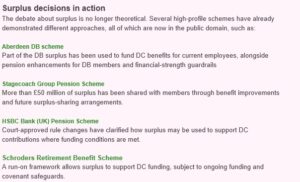
For smaller schemes, simplicity matters
Smaller schemes should be realistic about fixed governance and advisory costs, but this does not mean run-on or surplus use is automatically unattractive. The decision is about value for money, not size alone.
A simple investment structure, proportionate governance calendar and clear decision framework can make run-on manageable. Equally, buyout and wind-up may still be the right answer where certainty and simplicity outweigh the potential value of retaining surplus flexibility.
Post-buy-in surplus is also uncertain until insurer pricing has been tested and final costs and adjustments are known. This uncertainty can be more pronounced for smaller schemes, where relatively modest pricing movements can materially change the residual amount.
Planning should therefore cover a range of outcomes rather than rely on a single estimate.
What we’re seeing
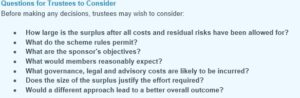
While every scheme is different, we are increasingly seeing trustees exploring surplus options earlier in their journey planning discussions, rather than waiting until after a transaction has completed. A number of our clients are currently engaged in active discussions to try and determine an appropriate framework for sharing surplus, whereby members may receive enhanced benefits, while allowing a portion of the surplus to be returned to the sponsoring employer.
That early thinking allows stakeholders to understand their powers, assess the range of possible outcomes and avoid being forced into decisions under time-pressure.
For further background, see The Pensions Regulator’s interim statement on new DB surplus flexibilities and Hymans Robertson’s “Whose surplus is it anyway?” article.
Key takeaways:
- A surplus is increasingly likely to be part of the endgame conversation.
- There is no single “right” answer. Options depend on scheme powers, objectives and stakeholder priorities.
- The best outcomes are usually achieved when trustees and sponsors begin planning well before a transaction completes.

Back