
With global equities riding high and proving (so far) resilient to the threat of US tariffs, we asked Mark Hodgson of Purple Daffodil Consulting for his thoughts on whether now is a good time to be investing in equities.
Where next for equity markets?
You can always find a reason to invest in equities and just as easily find a reason not to. However, as a self-confessed “centre-pessimist” you can probably guess which way I lean.
First and foremost, let’s make it clear that there are no recommendations in here, past performance is no guarantee of anything, especially the future, and this should in no way be taken as advice! We are also only talking about an investor looking for return; pension schemes have other things to worry about. Liabilities, for one. That’s the compliance done!
When thinking about equities, a good place to start is the long term. Over the very long-term (think decades), equities have been the best performing major asset class: better than bonds, gold, real estate, hedge funds and cash (for those screaming cryptocurrency – it does not have a long-term, yet). However, as your timeframe shrinks so does the probability that equities will deliver.
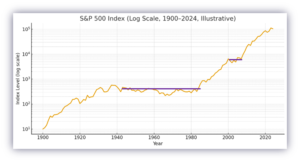
In fact, there are periods when equities do not deliver much at all.
* Source: Barclays Equity Gilt Study
The chart shows the price movement of the S&P 500* index on a logarithmic scale (and before 1957 the data is from the S&P Composite or a proxy to it). The surprise is that the market did very little for a long period before we had the exuberance of the 1980’s. I know we are only talking price but it makes the point. We then had the lost decade from the end of 1999, as the Dot-Com bubble burst followed by the Global Financial Crisis in 2008, which resulted in the S&P 500 taking 10 years to recover.
So, it may be true that being in equities with a long time horizon is a good thing but being in equities for a short period can be painful.
As Peter Lynch, the renowned Fidelity equity manager, put it:
It is “time in the markets, not timing the markets, that matters”.
That is not to say that if you do call the market, you cannot make more money: you absolutely can. However, as he also said:
More money has been lost by investors preparing for corrections, or trying to anticipate corrections, than has been lost in corrections themselves.
If you can call the markets, I am sure you are at peace in one of your many houses drinking the best champagne but I’m not sure why you are reading this!
Not extremely helpful I know, but for those who are keen to make that call, here is where we are now.
The case for equities
The case for equities is dominated by stabilising inflation and the growth of AI. Low and stable inflation is more supportive of equities, with less stress on company profitability as input costs are manageable and corporate pricing less strained. It also tends to mean lower interest rates, which is something the US administration is keen on, not least to tame ballooning debt interest costs. Lower rates mean that future cashflows are valued more highly and therefore valuations can be higher. Companies with profitability further into the future therefore benefit more from lower rates – certain technology stocks, for example.
The expected growth of AI has not only driven the Magnificent Seven* higher but has also had a positive effect on other companies who are benefiting from its use. Early adopters of AI have seen their stock price rise by 2.4% more per quarter than those who are slow to engage, according to the European Central Bank.
There are also sectors and regions more likely to outperform, such as companies supporting energy transition or countries where there is infrastructure spending: for example, Germany which, in March, announced €500bn for infrastructure and climate-neutrality over 12 years.

* The Magnificent Seven: Meta, Amazon, Apple, Microsoft, Tesla, Nvidia, Alphabet/Google
The case against equities
The case against equities is almost the reverse: inflationary pressures, stretched valuations, geopolitics and national debt. Inflation, whilst stabilising, is still at risk from tariffs and sticky wage inflation. Tariffs have “settled” at levels not seen for nearly a century, which is still feeding through into prices – pre-tariff stockpiling will run out and higher costs incurred. Those companies that had put off raising prices may have to start.
There is also the much wider topic: global debt. With governments sitting on huge debt piles, the ability to support a struggling economy becomes even harder: there is less “wriggle room”. Governments require more money to service debt as well as to fill budget deficits. Something has to give: tax rises suppress demand and more borrowing drives up yields and, if currency weakens, risks inflation. The result could be the dreaded stagflation – bad news for companies and individuals alike.
Valuations, as measured by price to earnings, are above their long-term average. Bond yields are close to or, in some cases above, trailing equity yields which implies some strong expected growth already being priced in.
In terms of AI, there is a huge amount of capital expenditure. S&P Global suggested that 80% of the increase in private domestic demand in the first half of 2025 was from data centre and related technology investments. That has a two-fold impact: it further concentrates markets, squeezing investment from other areas; and it means companies spending vast sums are increasing debt and/or reducing profitability in the near term. This is not to mention the environmental impact, which is a topic for another day.
Finally, geopolitics. There is not enough space to go through them all here or to give a view, which would be divisive anyway – all views are. However, with conflict flash points, Western fiscal stress and political uncertainty there are plenty of potential sparks, any of which could impact markets.
In summary
In our view, equities remain the best long-term route to real (inflation adjusted) returns. However, the short term is rarely smooth and I believe there are head winds today that could hold up any meaningful returns from equity markets (although there will be pockets of opportunity). Then again, I said that two years ago and I was very wrong! Time will prove me right but I just can’t quantify how much time – I only wish I could.
If you would like to hear more on this or any other investment topic please get in touch with Mark Hodgson at Purple Daffodil Consulting, or visit their website at www.purpledaffodilconsulting.com.
Back